San Antonio’s Sliding Glass Door Heat Problem
If you live in Shavano Park or Hill Country Village, you already know the punishment your sliding glass doors take from May through October. Those beautiful patio access points that sold you on your open-concept Texas home are now costing you money every single month. CPS Energy bills spike when unprotected glass becomes a solar oven, and that leather sectional you bought at La Cantera is fading faster than a chalk drawing in a thunderstorm.
San Antonio receives an average of 220 sunny days per year, significantly more than the national average of 205 days (Source: U.S. Climate Data, National Centers for Environmental Information, 2023). Your sliding doors—typically 6 to 12 feet wide—act as massive thermal entry points. During peak summer, unshaded south-facing glass can allow solar heat gain equivalent to a 1,500-watt space heater running continuously (Source: U.S. Department of Energy, Office of Energy Efficiency and Renewable Energy, 2022).
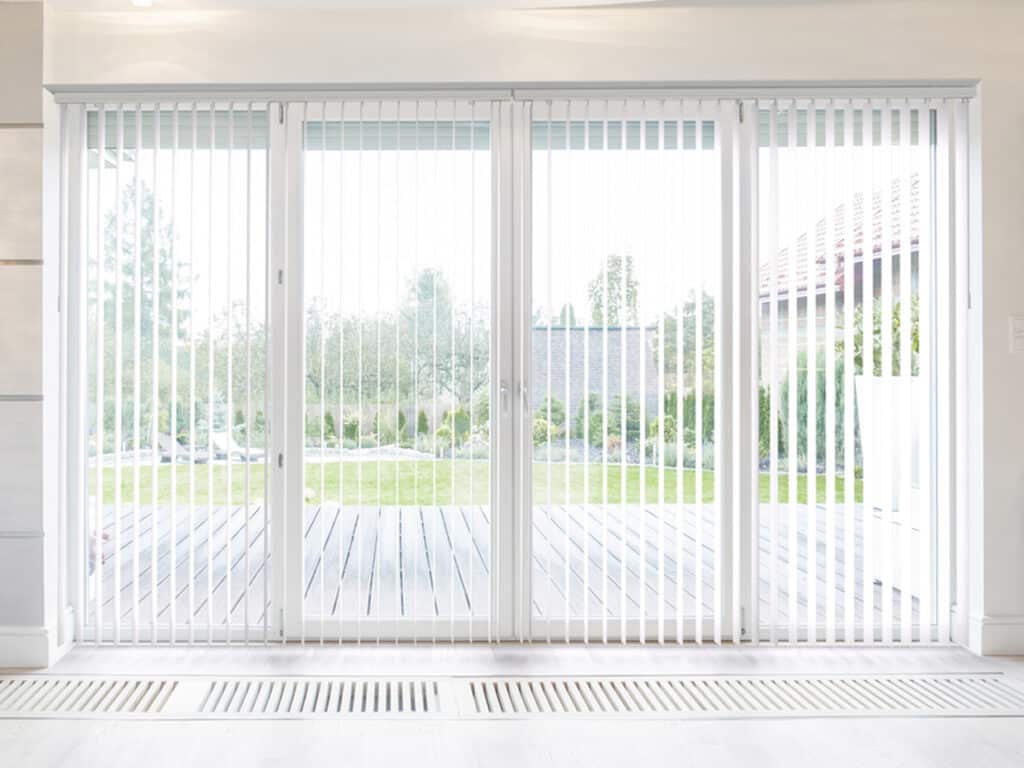
Vertical blinds for sliding doors solve this San Antonio-specific challenge by providing adjustable light control, thermal protection, and unobstructed patio access—all without the operational headaches of horizontal alternatives.
Why Vertical Blinds Outperform Other Patio Door Coverings in Texas
Heat Management for Open-Concept Floor Plans
Texas homes built since 2005 feature open-concept layouts at rates exceeding 67% of new construction (Source: National Association of Home Builders, What Home Buyers Really Want Survey, 2021). These designs rely heavily on large sliding glass doors to connect indoor and outdoor living spaces. The problem? That same openness means your CPS Energy air conditioning fights a losing battle against uncontrolled solar gain.
Vertical blinds with reflective backing can reduce solar heat gain through glass by 33% when fully closed (Source: Lawrence Berkeley National Laboratory, Windows and Daylighting Group, 2020). For San Antonio homeowners, this translates directly to lower cooling costs during our seven-month warm season.
Superior UV Protection for Interior Furnishings
San Antonio’s UV index regularly reaches 10 or higher during summer months—classified as “very high” by the EPA (Source: U.S. Environmental Protection Agency, UV Index Scale, 2023). That intensity destroys interior furnishings faster than homeowners expect. Hardwood floors near unprotected sliding doors can show visible fading within 6 months of installation.
Quality vertical blinds block up to 99% of UV rays when closed, protecting your investments in flooring, furniture, and artwork. For homes near The Rim shopping centers where many residents have invested in premium interior finishes, this protection pays for itself.
Practical Patio Access Without Compromise
Unlike horizontal blinds that require lifting, or curtains that bunch awkwardly, vertical shades San Antonio homeowners choose stack neatly to one side. You maintain full door clearance for:
- Daily patio access without tangling
- Pet doors integrated into sliding systems
- Party hosting where indoor-outdoor flow matters
- Emergency egress (a Texas building code requirement)
Selecting Vertical Blinds for San Antonio Conditions
Material Options Ranked for Texas Performance
Not every vertical blind material handles San Antonio’s climate demands equally. Your selection should prioritize thermal performance and durability under intense UV exposure.
| Material | Heat Reduction | UV Blocking | Best For |
|---|---|---|---|
| PVC/Vinyl | Excellent | 99% | South/west-facing doors |
| Fabric (lined) | Very Good | 95-99% | Style-conscious homeowners |
| Fabric (unlined) | Moderate | 70-85% | North-facing only |
| Faux Wood | Good | 99% | Traditional Texas aesthetics |
For Hill Country Village homes with west-facing patios overlooking limestone landscapes, PVC verticals with reflective backing deliver the best thermal performance. Shavano Park residences with covered patios may have more flexibility for fabric options that complement interior design.
Color Selection for Maximum Efficiency
Light-colored vertical blinds reflect more solar radiation than dark alternatives. White or cream blinds can reflect up to 77% of incoming solar energy, compared to just 12% for dark colors (Source: U.S. Department of Energy, Energy Saver Guide, 2023). In San Antonio’s climate, this difference directly impacts your CPS Energy bills from April through October.
“White-backed window treatments facing the glass side can reduce cooling loads by 20% compared to uncovered windows, with the greatest impact in hot-humid climate zones like South Texas.” — Department of Energy, Residential Windows and Shading Research Brief, 2022
Sizing Considerations for Texas Sliding Doors
Standard sliding patio doors in Texas homes range from 60 inches to 144 inches wide. Proper measurement matters because vertical blinds require precise fitting to:
- Prevent light gaps that compromise UV protection
- Ensure smooth operation without binding
- Maintain proper stack-back clearance for full door access
- Support the weight of wider installations without sagging
Professional measurement accounts for door frame depth, handle clearance, and track mounting options that DIY measurements often miss. For oversized sliding systems common in newer San Antonio construction, reinforced headrails prevent the sagging issues that plague big-box store installations.
Installation and Maintenance for San Antonio Homes
Professional vs. DIY: What Texas Conditions Demand
While vertical blinds appear straightforward, San Antonio’s specific challenges favor professional installation. Our humidity fluctuations—from 30% during drought to 90% after gulf moisture arrives—cause materials to expand and contract. Professional installers account for these variations when setting track spacing and vane alignment.
Additionally, Texas building codes require that window treatments near doors maintain proper egress clearance. A professional ensures your sliding glass door coverings meet safety requirements while maximizing performance.
Maintaining Your Investment in Texas Conditions
San Antonio’s combination of heat, UV exposure, and occasional dust storms requires specific maintenance practices:
- Wipe PVC vanes monthly with damp cloth to remove dust accumulation
- Lubricate track mechanisms twice yearly (spring and fall)
- Inspect vane clips annually for UV degradation
- Vacuum fabric verticals using brush attachment to prevent dust embedding
- Check headrail mounting annually—thermal cycling can loosen fasteners
Well-maintained vertical blinds last 10-15 years in San Antonio conditions, compared to 5-7 years for neglected installations.
Why San Antonio Homeowners Choose Local Expertise
Understanding Our Specific Market
National chains selling patio door blinds Texas homeowners install often ship products designed for temperate climates. San Antonio requires different specifications. Local expertise means understanding that a home near La Cantera faces different exposure than one in Shavano Park, and recommending products accordingly.
We measure onsite, account for your specific door orientation, and recommend materials proven in San Antonio’s demanding environment. No guessing about whether your blinds will handle July temperatures or January’s occasional ice storms.
CPS Energy Savings You Can Measure
Homeowners report average cooling cost reductions of 15-20% after installing properly selected and fitted vertical blinds on large sliding doors (Source: American Council for an Energy-Efficient Economy, Window Attachment Energy Performance Analysis, 2021). For San Antonio homes with multiple sliding access points—common in our market—the cumulative savings offset installation costs within 2-4 cooling seasons.
Get your free sliding door measurement and vertical blinds quote for your San Antonio patio access today. We serve all neighborhoods from Hill Country Village to Shavano Park and throughout the greater San Antonio area.
Frequently Asked Questions About Vertical Blinds for Sliding Doors
Do vertical blinds work with 12-foot sliding doors common in newer San Antonio construction?
Yes, commercial-grade headrails support spans up to 192 inches without center support brackets. For doors exceeding 144 inches, we recommend split-draw configurations that stack vanes to both sides, maintaining clear center access while preventing the headrail stress that causes premature failure in single-draw systems.
How do vertical blinds compare to sliding panel tracks for Texas patio doors?
Panel tracks offer a modern aesthetic but require more clearance for panel storage and provide less precise light control. Vertical blinds allow vane-angle adjustment from full-closed to fully open in infinite increments, letting you balance light, privacy, and heat control throughout the day—particularly valuable during San Antonio’s intense afternoon sun.
Can I integrate motorized controls with vertical blinds for smart home systems?
Modern vertical blind systems accept battery-powered and hardwired motors compatible with Alexa, Google Home, and dedicated home automation platforms. Motorized operation eliminates cord hazards while enabling scheduled positioning—automatically closing during peak heat hours to maximize your CPS Energy savings without daily manual adjustment.
Frequently Asked Questions
Do vertical blinds work with 12-foot sliding doors common in newer San Antonio construction?
Yes, commercial-grade headrails support spans up to 192 inches without center support brackets. For doors exceeding 144 inches, we recommend split-draw configurations that stack vanes to both sides, maintaining clear center access while preventing the headrail stress that causes premature failure in single-draw systems.
How do vertical blinds compare to sliding panel tracks for Texas patio doors?
Panel tracks offer a modern aesthetic but require more clearance for panel storage and provide less precise light control. Vertical blinds allow vane-angle adjustment from full-closed to fully open in infinite increments, letting you balance light, privacy, and heat control throughout the day—particularly valuable during San Antonio’s intense afternoon sun.
Can I integrate motorized controls with vertical blinds for smart home systems?
Modern vertical blind systems accept battery-powered and hardwired motors compatible with Alexa, Google Home, and dedicated home automation platforms. Motorized operation eliminates cord hazards while enabling scheduled positioning—automatically closing during peak heat hours to maximize your CPS Energy savings without daily manual adjustment.